You made twelve bottles last October. Maybe it was twenty-four. Either way, you’re not drinking them at restaurant pace — you pull one on a Tuesday, finish two-thirds of it, and the rest sits on the counter. Within a couple of days, something has gone quietly wrong. The wine has gone flat, picked up a stale edge, or started tasting like wet cardboard. What happened is oxidation: oxygen from the air reacted with the compounds in your wine and degraded them. It’s the same chemistry that turns a cut apple brown, just slower and more expensive. This article is about the tools home winemakers use to slow or prevent that process after a bottle has been opened — from a $10 rubber stopper with a hand pump to argon-gas systems used in serious home cellars. By the end, you’ll have a clear framework for matching the tool to your actual situation.
Why Opened Bottles Are a Different Problem Than Carboy Headspace
If you’ve been making wine for more than one season, you already understand headspace management in your fermentation and aging vessels. You know to keep carboys topped up, you’ve probably used a shot of argon or nitrogen from a Privée or Wine Preserve can to blanket the surface, and you’ve watched your SO₂ (sulfur dioxide) additions do the chemical work of mopping up dissolved oxygen before it can cause damage.
The Waterhouse Lab at UC Davis has published extensively on the mechanism: oxygen enters wine at the molecular level, and within hours of opening a standard 750ml bottle, the wine at the surface begins interacting with phenolic compounds — the building blocks of color, tannin structure, and aroma. For commercial wineries, this is why they run nitrogen sparging lines on their bottling equipment. For you, it’s why the last glass from a bottle opened four days ago tastes worse than the first.
Here’s where the home winemaker’s situation diverges from a casual consumer’s: you bottled in bulk, probably without a dosing station, and your SO₂ levels at bottling may vary bottle to bottle. That variability means some bottles will be more vulnerable than others. You also likely know the wine intimately — you know whether it’s a young, tannic red that will still show well in two days, or a delicate Riesling-style white where oxidation shows up in six hours.
The tools below exist on a spectrum from “slows the damage” to “nearly stops it.” Understanding where each falls — and the tradeoff between cost, convenience, and effectiveness — is the decision frame here.
The Preservation Tool Spectrum: What Each Method Actually Does
Vacuum Pumps and Rubber Stoppers
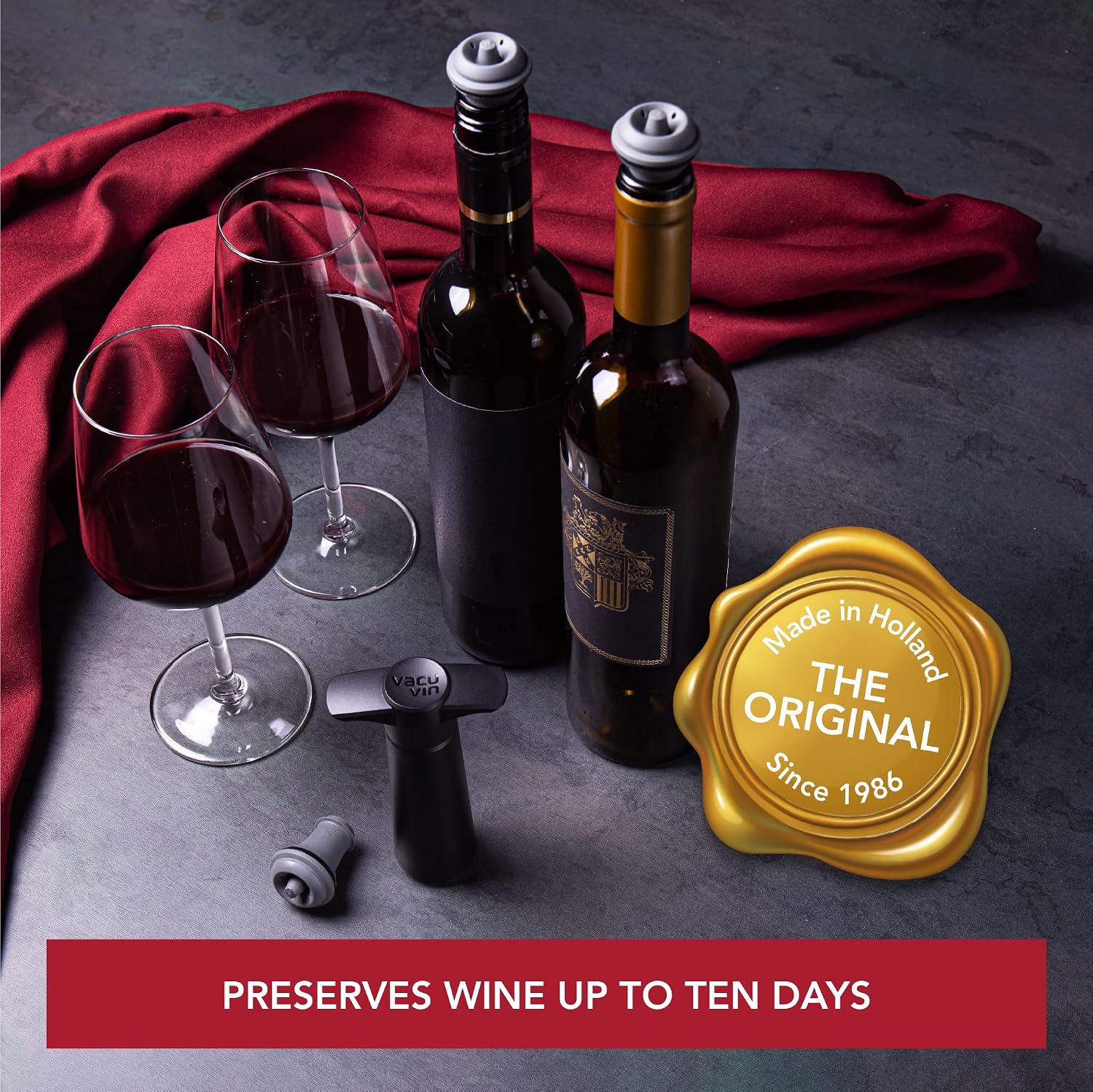
The most common entry point is a hand-operated vacuum pump — the kind that comes with a set of rubber stoppers. You insert the stopper, pump out some of the air above the wine, and the reduced oxygen partial pressure slows oxidation.
The key word is slows. Per WineMaker Magazine’s overview of oxidation prevention, vacuum pumps reduce but do not eliminate headspace oxygen. The stopper-and-pump approach works reasonably well for wines you’ll finish within two to three days. It’s meaningfully better than re-corking with a loose cork or a standard bottle stopper — but the rubber stoppers lose their seal over time, especially if the bottle neck has any irregularity from your bottling process.
The tradeoff: Inexpensive (the Vacu Vin system and its equivalents run $10–$15 at retail), widely available, and effortless to use. But they’re a delay strategy, not a solution, and owners consistently report that seal quality degrades after 6–12 months of regular use. If you’re drinking through your own bottles at a relaxed pace and finishing them within 48–72 hours, this is fine.
If you have a specific bottle in mind: [PRODUCT: vacuum wine stopper pump set — TIER: entry]
Wine Preservation Sprays (Inert Gas in a Can)
Products like Private Preserve spray a blend of inert gases — typically argon, carbon dioxide, and nitrogen — into the bottle before you re-cork. The gas sinks below the oxygen because it’s denser, forming a protective layer between the wine surface and the air above it.
MoreWine!‘s published guidance on SO₂ and preservation notes that inert gas blanketing is one of the most effective short-term preservation techniques available to home winemakers, especially for whites and rosés where oxidation is detectable quickly. The UC Davis Department of Viticulture and Enology’s research on dissolved oxygen underscores that even a brief exposure can cause measurable quality decline in sensitive wines.
The limitation: you can’t verify the blanket held. If you tip the bottle to pour, you disturb the gas layer. For bottles you’re returning to repeatedly over two to three days, re-spraying before re-corking each time maintains the blanket more reliably than hoping the initial dose persisted.
The tradeoff: A can runs approximately $10–$13 and provides 100+ uses by manufacturer specification. It’s the most effective per-use tool in this price range. The cost-per-use math strongly favors this over premium stoppers if you’re disciplined about re-applying. Works best with your original cork re-inserted snugly after spraying.
If you want to stock up: [PRODUCT: Private Preserve inert gas wine preservation spray — TIER: intermediate]
Stopper Upgrades: Silicone, Hinged, and Champagne-Style Closures
Not all rubber stoppers are created equal. Hinged-lever stoppers — the style often associated with sparkling wine closures — create a stronger mechanical seal than simple push-in rubber versions. Several owners of the Vacu Vin and similar systems report that the silicone-tipped variants hold a better vacuum than the original rubber versions, particularly on bottles where the neck diameter varies slightly from your bottling run.
For still wines, a good silicone stopper is a meaningful upgrade over a repurposed cork. For sparkling or semi-sparkling home productions (pétillant naturel, forced carbonation experiments), a champagne-style hinged stopper is essentially mandatory — a standard stopper won’t hold carbonation pressure.
The tradeoff: These are $5–$20 per stopper depending on material and construction. They do not address the fundamental oxygen problem; they just seal more reliably. Think of them as the foundation — you still want gas blanketing on top of a good seal, not one or the other.
Argon Wand Systems and Dispenser Units
A step up from spray cans are counter-top argon-dispense systems — devices that connect to a small food-grade argon cylinder and deliver a metered dose via a wand inserted into the bottle. These are common in restaurant wine-by-the-glass programs where a bottle may sit open for several service shifts.
Practical Winery & Vineyard Journal has documented inert gas use in small cellar operations, noting that argon (denser than nitrogen, and unlike CO₂, it doesn’t affect flavor at any realistic dose) is the preferred single-gas option for wine preservation. For a home winemaker drinking through six to twelve bottles a month of their own production, the economics look like this:
By the Numbers
- Spray can (Private Preserve, ~$12): 100+ applications ≈ $0.12/use
- Small argon cylinder for a dispense system (~$50–$80 refill): 200–400 applications ≈ $0.15–$0.25/use
- Counter-top argon dispenser unit (hardware cost): $150–$400 depending on system
- Break-even vs. spray cans: approximately 18–36 months at moderate use
The argon wand systems win on convenience (no re-spraying, metered dose, consistent delivery) but the economics only favor serious volume users. If you’re regularly opening and partially consuming your own bottles across a week — say, you’re evaluating how a batch is aging by opening one bottle every few days — the dispenser makes sense. For most intermediate home winemakers, the spray can covers the need.
If you want a dispense-system setup: [PRODUCT: Pek argon wine preserver system — TIER: advanced]
Matching Tool to Situation: The Decision Frame
Here is where the rubber meets the road. The “right” tool is not a function of how much you want to spend; it’s a function of your actual opening behavior and the wines you’re preserving.
If you open one bottle at a time and finish it within 48 hours: A silicone stopper and a single spray of inert gas before re-corking will cover you. Cost: under $25 total. Don’t overthink this.
If you open bottles more slowly — one glass every two or three days — and you’re working through a batch you know is lower in free SO₂: Inert gas spray, re-applied at every pour, combined with a reliable silicone stopper is your best practical option without capital investment. Consider this your floor.
If you regularly have three or more partially-open bottles at different stages and you want a systematic approach: An argon dispenser system earns its cost in both convenience and consistency. Pair it with accurate free SO₂ tracking from your bottling notes so you know which bottles in your rack are more vulnerable.
If you’re evaluating a batch for defects or aging progress: Open, assess, gas-blanket, stopper, and set a hard rule: re-evaluate and finish within five days. No preservation tool compensates for oxygen that’s been in contact with the wine for a week. The Waterhouse Lab’s published research suggests that after extended open-bottle storage, even well-preserved wines show flavor degradation that no tool fully prevents.
A Note on SO₂ at Bottling and Its Interaction With Preservation
One point worth making explicitly: the best post-opening preservation tool is the free SO₂ level you maintained at bottling. MoreWine!‘s technical guidance recommends targeting 0.5–0.8 mg/L molecular SO₂ at bottling (the exact target shifts with wine pH — lower pH wines need less total SO₂ to achieve that molecular level). A wine bottled with appropriate free SO₂ has a chemical buffer against early oxidation that a gas spray cannot replicate.
If your bottled wines are oxidizing quickly after opening, that’s worth diagnosing at the production level, not just managing at the glass level. Check your bottling records. Did you test free SO₂ before filling? Did your filling process introduce oxygen (gravity fill versus pump versus bench corker speed)? WineMaker Magazine’s technical archive covers these bottling-process oxygen pickup points in detail.
Preservation tools extend the window. They don’t replace the chemistry you built in the cellar.
The Bottom Line
For most intermediate home winemakers bottling in bulk: a quality silicone stopper paired with an inert gas spray is the practical sweet spot. It costs under $25 to assemble, works across every wine style, and extends open-bottle life by two to four days without any behavior change beyond a two-second spray before you re-cork.
If X is that you’re systematically working through your own production, opening bottles frequently to assess aging, and you want a professional-grade workflow — then Y is the argon dispenser system. The math eventually works in its favor, and more importantly, the consistency does.
If X is that you’re drinking bottles within a day or two and your SO₂ management at bottling is solid — then Y is the spray can, and everything else is a luxury.
Spend the extra twenty minutes on your next bottling day confirming your free SO₂. That’s where the real preservation work happens.