If you’ve been making wine at home for a season or two, you’ve probably accumulated a small collection of plastic fermentation buckets and glass carboys — the large, water-jug-shaped vessels that hold wine during and after fermentation. These workhorses are genuinely good starting points, but at some stage the limitations start to stack up: a bucket scratched on the inside that won’t fully sanitize, a 6-gallon glass carboy that weighs 55 pounds when full, a lid seal that isn’t quite right. At that point, a stainless steel conical fermenter (a vessel with a cone-shaped bottom that lets you drain off dead yeast without moving the wine) starts looking like a serious upgrade. VEVOR, a Chinese-based equipment brand that has flooded the home fermentation market with aggressively priced stainless conicals, is usually the first name that comes up. This article walks through when that upgrade genuinely pays off — and when it doesn’t.
What You’re Actually Buying: The Conical Fermenter Explained
A standard home winemaking setup uses a two-vessel system: an open primary fermentation bucket (where the wild yeast action happens and the cap of skins is punched down) and a closed secondary vessel — usually a glass or plastic carboy — where the wine finishes fermenting and begins aging. The transfer between vessels is always a risk point. Every time you rack (move wine from one container to another with a siphon), you introduce the possibility of oxidation — exposure to oxygen that can flatten aromas and eventually turn wine to vinegar — and the possibility of contamination.
A conical fermenter collapses that two-vessel model into one. The cone at the bottom funnels dead yeast cells (lees) into a small collection port, which you can dump without ever moving the wine. The vessel seals completely, and most designs include a port for an airlock (a simple one-way valve that lets CO₂ escape without letting oxygen in), temperature probe fittings, and a sample valve. You go from primary fermentation through bulk aging in a single vessel with fewer racking steps and less oxygen exposure. For red wines especially, that’s a meaningful quality lever.
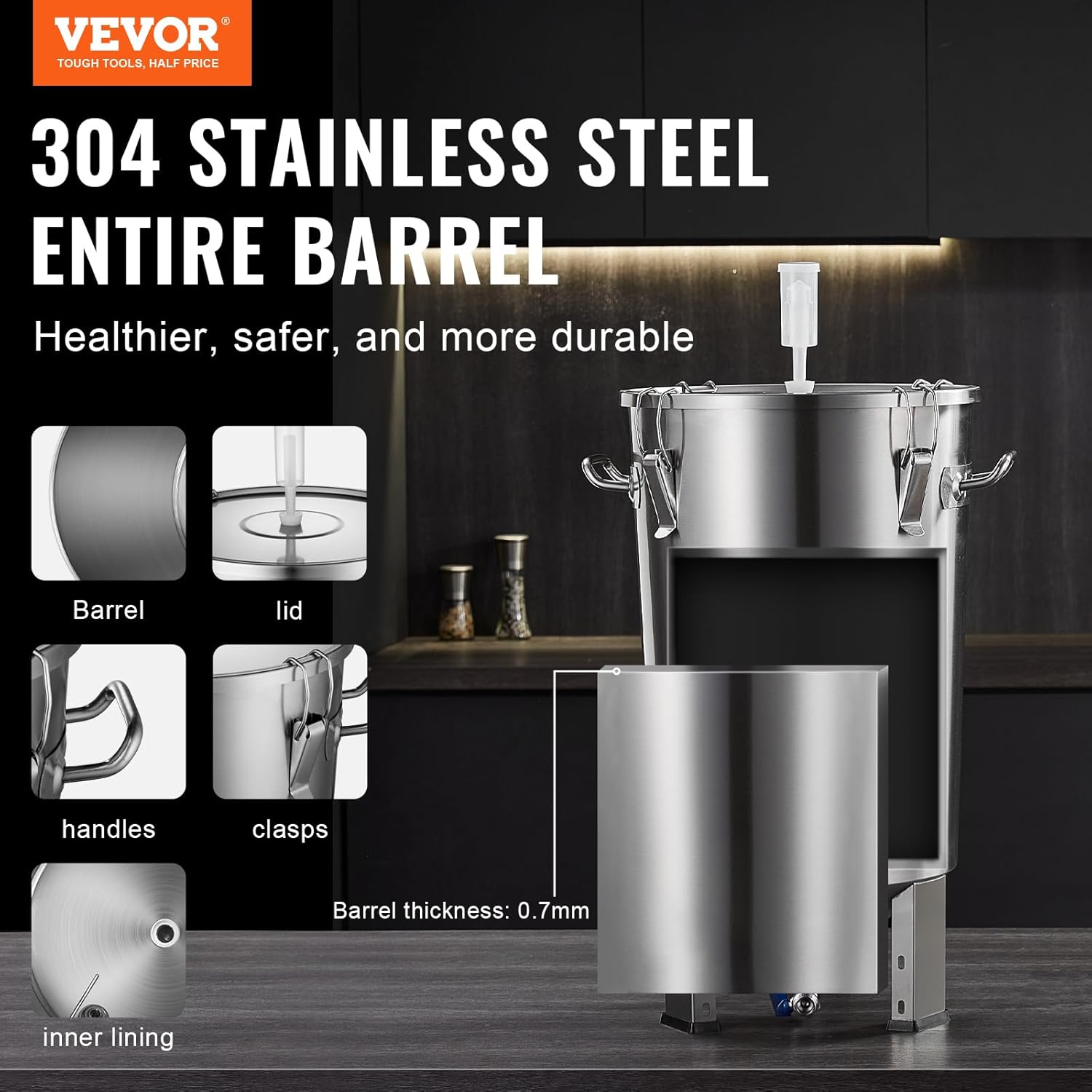
VEVOR’s entry in this space is a line of food-grade 304 stainless conicals ranging roughly from 7 to 30 gallons, typically selling in the $200–$500 range depending on size and configuration. They’re not the only player — MoreWine! carries Speidel and FastFerment options, BSG Handcraft stocks Blichmann and SS Brewtech units — but VEVOR consistently surfaces as the value floor the rest of the market prices against.
The Honest Trade-Off Matrix
Before going further, it’s worth being direct about what you’re trading when you move from a carboy-and-bucket setup to a stainless conical.
What you gain:
- Fewer racking steps, which means less dissolved oxygen introduced into the wine
- Easier lees management — dump the cone without disturbing the wine body
- Durability: food-grade stainless doesn’t scratch like plastic or shatter like glass
- Better long-term sanitation: a smooth stainless surface is easier to clean than scratched HDPE (high-density polyethylene, the plastic most buckets are made from)
- A professional workflow that scales — the same basic vessel design commercial wineries use
What you give up or complicate:
- Visibility: you cannot see what’s happening inside. Glass carboys let you monitor clarity, color, and activity visually. Stainless is opaque.
- Simplicity: conicals have more fittings, gaskets, and seals than a carboy with a bung. More points of failure, more parts to sanitize.
- Cost efficiency at small scale: for a 5-gallon batch, a $35 glass carboy does almost everything a $250 conical does.
- Portability: a 14-gallon stainless conical filled with wine is not moving. It lives where you put it.
Winemaker Magazine’s 2024 equipment issue frames this tradeoff cleanly: the oxygen-reduction benefit of a conical fermenter is most pronounced in batches of 10 gallons or more, where the economics of vessel cost per gallon start favoring stainless, and where the cumulative oxidation risk across multiple rackings is high enough to matter.
By the Numbers
| Batch size | Typical vessel option | Vessel cost (2026 market) | Cost per gallon |
|---|---|---|---|
| 5 gal | Glass carboy | $35–$50 | $7–$10 |
| 5 gal | VEVOR 7-gal conical | ~$220 | ~$44 |
| 14–15 gal | VEVOR 14-gal conical | ~$280–$320 | ~$19–$23 |
| 14–15 gal | Speidel 60L variable tank | ~$380–$420 | ~$25–$29 |
| 27–30 gal | VEVOR 30-gal conical | ~$420–$480 | ~$15–$17 |
The crossover point where stainless becomes cost-competitive on a per-gallon basis is roughly 12–15 gallons. Below that threshold, the glass carboy wins on economics every time.
Where VEVOR Sits in the Stainless Hierarchy
VEVOR is genuinely a different product category than Speidel, Blichmann, or Marchisio — not just a cheaper version of the same thing.
Construction: VEVOR conicals are built from 304 stainless, which is the food-grade industry standard and entirely appropriate for fermentation use. UC Davis’s Department of Viticulture and Enology notes in their fermentation vessel materials guidance that 304 stainless is suitable for wine contact and is standard across commercial facilities. What varies by manufacturer is weld quality, fitting tolerances, and gasket materials. Across aggregated owner reviews and forum discussion (sourced from home fermentation communities rather than any single retailer), the consistent pattern is that VEVOR units deliver acceptable construction for home use but occasionally require gasket replacement within the first season, and fitting threads sometimes need PTFE tape (the white plumber’s tape) to seal reliably. These are nuisances, not dealbreakers.
Fittings and accessories: Blichmann and SS Brewtech units — which typically run $500–$900 for comparable sizes — include better-toleranced tri-clamp fittings (the quick-release sanitary connectors professional breweries and wineries use), pressure-rated lids, and integrated cooling options. VEVOR uses threaded fittings throughout, which are perfectly functional but less flexible if you want to add professional accessories down the road. MoreWinemaking.com’s equipment guide on stainless fermenters specifically notes that tri-clamp compatibility is the key differentiator if you anticipate scaling to a micro-commercial setup.
Temperature control: Neither VEVOR conicals nor most entry-level stainless options include integrated cooling jackets. This matters more than most buyers anticipate. Controlling fermentation temperature — keeping reds in the 65–75°F range and whites cooler — is one of the highest-leverage quality variables a home winemaker controls. If your garage hits 85°F in August (common in most U.S. climates), a conical vessel does not solve that problem on its own. You’ll need an external solution: a dedicated fermentation chamber (a chest freezer with a temperature controller), an immersion coil, or a glycol chiller. BSG Handcraft’s 2025–2026 equipment catalog notes that the absence of integrated temperature control is the single most common gap between home-scale conicals and their commercial counterparts.
The Decision Framework: If X, Then Y
This is where the research points:
If your batches are under 10 gallons: Stay with glass carboys for secondary fermentation and add a variable-capacity wine tank (like a Speidel 10- or 20-liter) to reduce headspace — the airspace above wine that creates oxidation risk. The carboy-plus-variable-tank combination is cheaper, simpler, and the oxygen protection is nearly equivalent if you’re managing SO₂ additions (sulfite additions that bind free oxygen) correctly. MoreWinemaking.com’s SO₂ management guides are worth reading before spending money on new vessels — the chemistry often solves what the equipment is blamed for.
If your batches run 12–25 gallons and you’re making red wine: A VEVOR 14- or 22-gallon conical is a legitimate upgrade. The cost per gallon drops to a competitive range, lees management becomes genuinely easier with larger volumes, and the reduced racking frequency matters more as your batch size grows. Budget an additional $60–$120 for gasket replacements, quality PTFE tape, and a good tri-clamp airlock adapter to improve the stock fittings.
If you’re serious about temperature control: The VEVOR is a vessel, not a fermentation system. Budget for a chest freezer and an Inkbird or Ranco temperature controller ($100–$180 total) before or alongside the conical purchase. Practical Winery and Vineyard Journal’s coverage of small-format stainless consistently identifies temperature management as the variable that separates garage winemakers from garage winemakers whose wine consistently tastes good.
If you’re building toward micro-commercial production (50+ gallons, farm winery, or cottage winery permit): Skip VEVOR and buy used commercial equipment or new Speidel/Marchisio. The Marchisio variable-capacity stainless tanks (available through BSG Handcraft and other enological supply houses) are priced in the $600–$1,800 range for 30–120 liter sizes, built to Italian winery standards, and carry the resale value and regulatory documentation that matters if you’re ever in front of a health inspector or a licensed winery auditor. VEVOR’s documentation trail is thin enough that some state cottage winery programs won’t accept it as an approved vessel for licensed production.
If you’re on the fence about batch scale: Buy the larger conical than you think you need. The single most common home winemaker regret, per Winemaker Magazine reader surveys cited in their 2024 equipment issue, is undersizing fermentation vessels. Headspace math always wins: a 22-gallon conical running a 14-gallon batch is safer than a 14-gallon conical crammed full.
A Note on Sourcing
VEVOR conicals are widely available through major online retailers (listed by name only — product markers below). For comparably priced alternatives worth examining, MoreWine! (morewinemaking.com) stocks the FastFerment conical in a 7.9-gallon food-grade plastic version that captures much of the lees-management benefit at lower cost — a useful intermediate step if you’re not ready to commit to stainless. BSG Handcraft carries Blichmann Engineering’s Fermenator line for buyers who want the full professional specification. And for the prosumer buyer evaluating Speidel or Marchisio tanks, both MoreWine! and BSG Handcraft carry the full lines with the technical support that VEVOR purchases don’t include.
The equipment decision is downstream of the process decision. Get your pH and SO₂ management dialed in first — the UC Davis wineserver resources and MoreWinemaking.com’s enological additive guides are the right starting points — and then match vessel investment to batch ambition. The VEVOR conical earns its place in a specific window of that upgrade path. Outside that window, there are better answers on both sides.
{% product_marker vevor_conical_14gal tier=“intermediate” %} {% product_marker speidel_variable_tank_60L tier=“prosumer” %} {% product_marker inkbird_temperature_controller tier=“intermediate” %}