If you’ve ever stared at a freshly crushed bucket of grape must and wondered whether your fruit had enough sugar to hit 12% alcohol — or whether fermentation had actually finished before you sealed up that carboy — you’ve already felt the need for a sugar-measuring instrument. Sugar content is the engine number of winemaking: it tells you where you’re starting, how far you’ve traveled, and whether it’s safe to stop. The two tools home and craft winemakers use to measure it are the hydrometer (a sealed glass float dropped into a sample tube — the denser the liquid, the higher it floats) and the refractometer (a handheld optical device that bends a few drops of juice through a prism to read sugar concentration). Both measure essentially the same thing. They cost anywhere from $10 to $60 for quality versions. And yet choosing the wrong one for your stage — or misreading the one you own — is one of the most common sources of bad fermentation math in the hobby. This guide lays out exactly when each tool earns its place, where each one misleads you, and how serious producers use both.
What Each Instrument Actually Measures — and Where the Numbers Come From
Both tools express sugar concentration, but they use different scales and different physical principles, and that distinction matters the moment alcohol enters the picture.
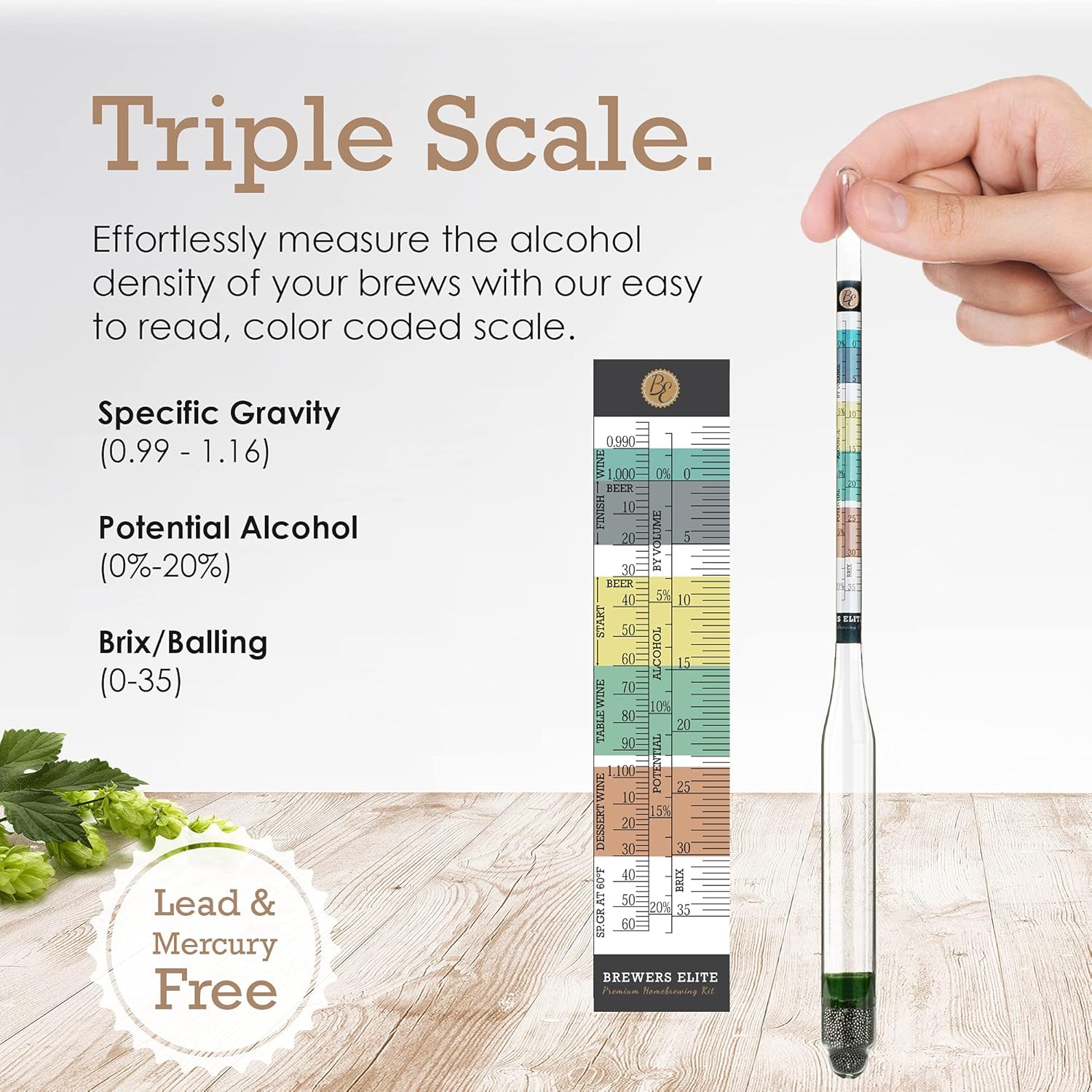
The hydrometer measures specific gravity (SG) — the density of your liquid relative to water. Pure water sits at 1.000. Fresh grape juice loaded with sugar reads somewhere between 1.070 and 1.110 depending on ripeness and variety. As yeast consume sugar and produce alcohol (which is less dense than water), the SG drops. A finished dry wine typically reads between 0.990 and 0.998. The standard formula for converting SG readings into estimated ABV — published in the MoreWinemaking Technical Reference, “Hydrometer Use and Calibration” — is ABV ≈ (OG − FG) × 131.25, where OG is your original gravity and FG is your final gravity. A wine that started at 1.095 and finished at 0.994 works out to roughly 13.2% ABV by that formula.
Hydrometer readings are also commonly expressed in Brix — a scale where 1 degree Brix equals 1 gram of sucrose per 100 grams of solution. Most hydrometers sold for winemaking show both scales. The UC Davis Department of Viticulture and Enology uses Brix as its primary measurement in harvest maturity documentation, and most commercial vineyard contracts are written in Brix targets, so fluency in both SG and Brix is worth building early.
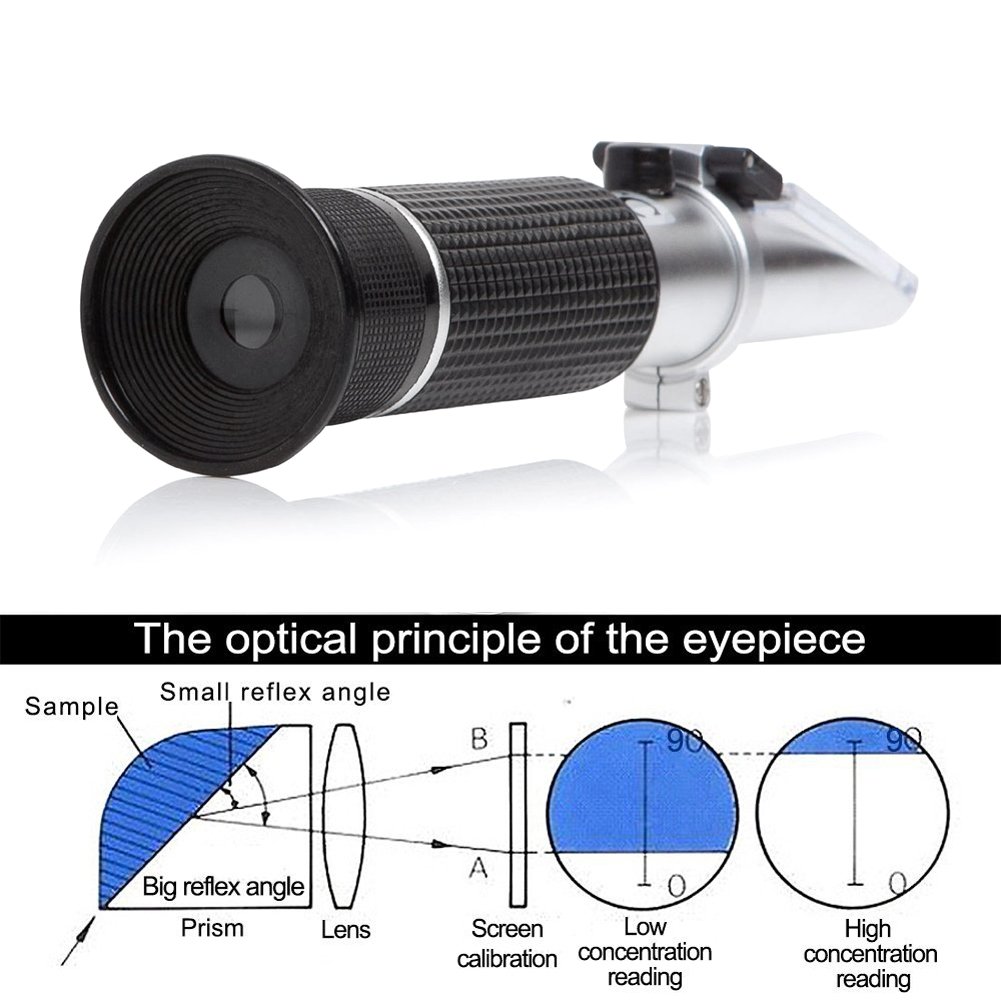
The refractometer also reads Brix, but it does so by measuring how much a liquid bends (refracts) light. You place one or two drops on the prism, fold down the cover plate, hold it toward a light source, and read the scale through the eyepiece. The reading takes five seconds. You don’t need a sample tube, a graduated cylinder, or a 100 ml pull from a carboy. That speed and minimal-sample requirement is the refractometer’s entire value proposition at harvest.
The critical limitation of the refractometer: alcohol and sugar refract light differently, but the instrument’s scale is calibrated only for sugar in water. Once fermentation begins and ethanol builds up in solution, refractometer readings become progressively inaccurate — they read lower than the actual sugar level because ethanol has a lower refractive index than water. Penn State Extension, in its guidance document “Testing Grape Juice and Must for Home Winemakers,” flags this directly: refractometer readings taken mid-fermentation or at the finish are not reliable for determining residual sugar or estimating final ABV without a correction formula. The cleaner solution is simply to use the right tool at the right stage.
The Decision Frame: Pre-Fermentation vs. During and After
This is the practical split that resolves most of the hydrometer-vs-refractometer debate:
| Stage | Best Tool | Why |
|---|---|---|
| Vineyard / harvest sampling | Refractometer | Tiny sample, instant read, no tube needed |
| Must at crush | Either (refractometer for speed, hydrometer for precision) | No alcohol present yet — both are accurate |
| Active fermentation (day 2 onward) | Hydrometer only | Alcohol invalidates refractometer scale |
| Final gravity / dryness check | Hydrometer only | Confirms true residual sugar for stability |
| ABV estimation | Hydrometer (OG + FG) | Requires two density readings across fermentation |
By the numbers — example harvest scenario:
- Refractometer reads 23.5 °Brix at the vineyard → target range confirmed, pick date set
- Hydrometer reads 1.097 SG (≈ 23.1 °Brix) on crushed must — close agreement, no alcohol yet
- Hydrometer reads 0.995 SG at completion → estimated ABV: (1.097 − 0.995) × 131.25 = 13.4%
The refractometer earned its keep at the vineyard. The hydrometer earned its keep at every step that followed.
Buying Guidance: Matching the Instrument to Your Budget and Stage
The comparison below is organized into three tiers. Each tier solves a real problem at a specific level of involvement — from first-batch kit winemakers to small-lot grape growers who need both instruments working in tandem.
Entry-Level Hydrometer ($8–$20)
A basic triple-scale wine hydrometer — showing SG, Brix, and potential alcohol — is the minimum viable instrument for any winemaker at any stage. BSG Handcraft’s technical bulletin “Density Measurement in Small-Scale Fermentation” recommends hydrometers calibrated to 60°F/15.5°C as the standard for North American winemaking use, since most published tables and conversion formulas are referenced to that temperature. If you’re reading at a different temperature — must straight off warm fruit, or a cellar running at 55°F — you’ll need to apply a temperature correction chart. Most hydrometers ship with one, and the MoreWinemaking Technical Reference, “Hydrometer Use and Calibration,” publishes the correction factors as well.
What owners consistently report at this tier: the fragility of the glass tube is the main limitation, not the accuracy. A replacement hydrometer costs $10–$15, and most serious makers keep two on hand.
Affiliate pick — entry tier: a standard triple-scale wine hydrometer rated to 1.000–1.170 SG, with a plastic sample tube included. [PRODUCT:hydrometer-wine-triple-scale:entry]
Brix
$17.99
In stock on Amazon
Check price on AmazonMid-Range Hydrometer with Thermometer ($15–$35)
The most meaningful upgrade from the entry tier is a built-in or included thermometer so you can apply temperature corrections without reaching for a second instrument. Winemaker Magazine’s practical guide “Understanding Specific Gravity and Brix in Home Winemaking” emphasizes that a 10°F temperature error can shift a hydrometer reading by as much as 0.002 SG — small in absolute terms but meaningful when you’re trying to confirm a wine is genuinely dry at 0.994 versus still-sweet at 0.998.
For winemakers who ferment in temperature-variable spaces — a garage in spring, a basement in fall — the thermometer combo pays for itself in the first batch where temperature swings more than 10°F between readings.
Affiliate pick — mid tier: a combination hydrometer and thermometer set with a wide-diameter sample tube. [PRODUCT:hydrometer-thermometer-combo:mid]
Brewer's
$21.99
In stock on Amazon
Check price on AmazonRefractometer for Harvest and Must Sampling ($20–$60)
For harvest use and must sampling, a 0–32 °Brix handheld refractometer with automatic temperature compensation (ATC) is the appropriate specification. ATC corrects for ambient temperature variation automatically — important when you’re sampling fruit in an outdoor vineyard at temperatures that may swing 20°F across a day. Models without ATC can produce readings that drift by 0.5–1.5 °Brix in field conditions.
Look for: a wide prism cover (easier to clean between samples), a daylight-readable scale, and a calibration screw so you can zero the instrument with distilled water before each use. Calibration should be confirmed before every harvest day.
Most ATC refractometers in the $25–$50 range specify ±0.2 °Brix accuracy, which is sufficient for winemaking decisions. Accuracy differences between a $30 and a $55 model in this category are generally within instrument-to-instrument variation rather than meaningful tier differences — the ATC feature matters more than the price.
Important reminder: once you pitch yeast, put the refractometer away. As noted by Penn State Extension’s guidance for home winemakers, it will give you misleading readings the moment alcohol builds in solution. The hydrometer takes over from that point forward and doesn’t hand the job back.
Affiliate pick — refractometer: a 0–32 Brix ATC handheld refractometer with calibration screwdriver included. [PRODUCT:refractometer-wine-brix-atc:mid]
3-in-1
$89.99
In stock on Amazon
Check price on AmazonProfessional-Grade Consideration: Digital Density Meters ($150–$600+)
Serious craft producers and micro-commercial winemakers who want to eliminate temperature-correction math entirely increasingly look at digital density meters — instruments that use an oscillating U-tube to give a direct SG or °Brix reading without manual temperature adjustment. Entry-level professional models begin around $400–$600. For a farm winery making 500–2,000 cases annually, the time saved across dozens of fermentation checks per vintage may justify the investment. For a home winemaker doing three to six 5-gallon batches a year, the math does not close.
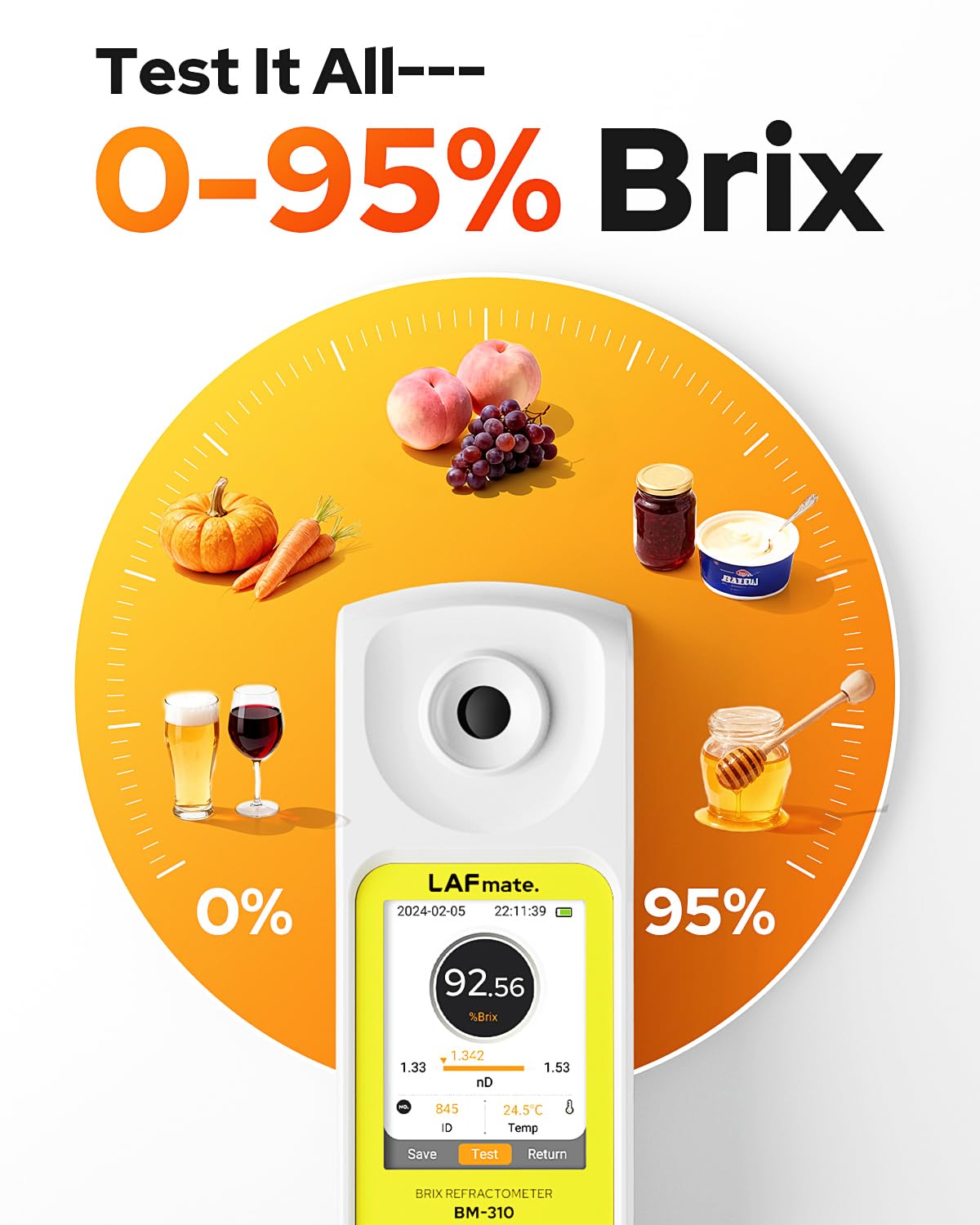
The middle ground — benchtop digital refractometers in the $150–$250 range — offers convenience but still carries the alcohol-present limitation of any refractometer. The standard hydrometer remains the right finishing instrument regardless of how much you spend on front-end measurement.
Common Errors That Skew Your Numbers
1. Reading a hydrometer without clearing CO2 bubbles. Active fermentation saturates must with carbon dioxide, which clings to the hydrometer and makes it float higher than liquid density alone warrants — producing a falsely high (too-sweet) reading. Spin the hydrometer gently in the tube or let the sample sit 30 seconds before reading. The MoreWinemaking Technical Reference, “Hydrometer Use and Calibration,” specifically flags this as a top source of mid-fermentation misreadings.
2. Using a refractometer mid-fermentation without a correction formula. The alcohol error compounds with every passing day. A reading of 4 °Brix on day 8 of fermentation does not mean the wine is nearly finished — it may be masking a true residual sugar several points higher. Default to the hydrometer the moment you pitch yeast.
3. Not recording your original gravity. ABV estimation requires two data points. Winemakers who forget to take or record their OG before pitching yeast lose the ability to estimate ABV from density alone. The refractometer’s speed advantage at crush makes it easier to grab that first reading before juice is transferred — which is one more reason to have both instruments in your kit.
4. Temperature drift on uncorrected hydrometers. A must reading taken at 75°F will read approximately 0.002 SG lower than the same liquid measured at 60°F. Over a 15-degree spread, that translates to roughly 0.3% ABV error. Penn State Extension’s home winemaking guidance, “Testing Grape Juice and Must for Home Winemakers,” includes a correction table; so does the insert card in most quality hydrometers.
The Decision Rule
If you’re choosing one instrument to start: buy the hydrometer first. It covers every stage of fermentation — from original gravity through final dryness — and the ABV math requires it regardless of what else you own. A quality triple-scale hydrometer with sample tube costs under $20 and is sufficient for complete fermentation tracking.
When you’re actively sourcing grapes or working from a vineyard rather than a kit: add a refractometer before harvest. The ability to pull a reading from three berries in 10 seconds — without carrying a sample tube into the vineyard rows — earns the $30–$40 purchase price in the first morning of sampling.
If X, then Y:
- You’re making wine from kits or pre-pressed juice → hydrometer only; a refractometer adds nothing until you’re working with whole fruit
- You’re sourcing fresh grapes or working with a vineyard → own both; refractometer at harvest, hydrometer through fermentation
- You’re running 10+ fermentations per vintage at a micro-commercial scale → evaluate a digital density meter; the long-run time savings on temperature correction may justify the cost
- You’re mid-fermentation and your refractometer is the only instrument you have → stop relying on it for fermentation tracking and acquire a hydrometer before making another gravity-based decision on that batch
The instruments themselves are inexpensive. The fermentation decisions they inform are not. Get both into your kit, know which one to reach for at each stage, and the math will take care of the rest.